Is the flu vaccine worth getting? (SPOILER: Yes.)
You know, whenever I write about vaccines, the crazies come out of the woodwork. So I fully expect the regular mindless accusations that I’m a “pharma shill” or stuff like that. Cool, cool. Always a good time.
Well, let’s get into it.
I want to start today with the case of one Dr. Robert Malone, famed curmudgeonly opponent to seemingly all modern vaccination.
If you don’t know, Malone is a medical contrarian who claimed to have invented mRNA vaccines (he did not), and that the COVID vaccines are more dangerous than the disease (they are not), and that the COVID disease was not a big deal (it was, and still is).
In this post, viewed 1.8 million times on the social media website X (if you believe its metrics), Malone says flu vaccines are “ineffective.”
Of course, his statement is nonsense. But I feel it’s necessary to investigate his claim and explain why it is nonsense. Let’s begin.
The seasonal flu vaccine changes every year because the circulating strains of influenza are different every year. Since it takes months to manufacture the vaccine, scientists have to make an educated guess months in advance about what the virus-mix will be for the coming season.
Some years they get it more right than others. The closer the match, the more effective the vaccine.
Here's a summary of recent efficacy estimates from the CDC (before it was dismantled):
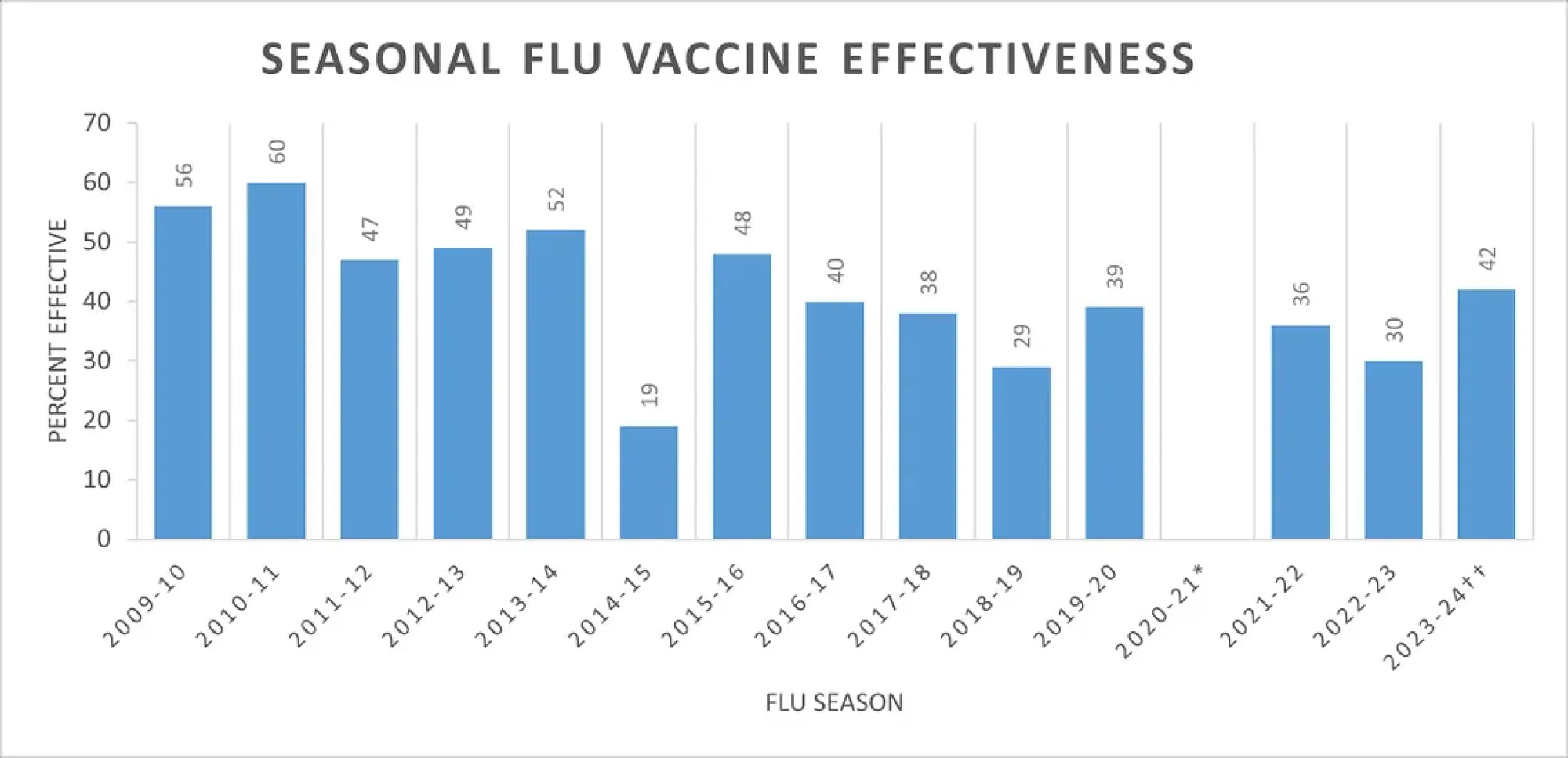
As you can see, some seasons saw very poor efficacy (19%) while others saw a high of 60%. In general, I tend to expect an efficacy of ~40%.
To laypeople, 40% is atrociously low. Most expect a vaccine to guarantee protection.
But my friends, the world is never so kind.
To population scientists like me, 40% is actually an impactful number. The mistake most make is to only think about individual experience and risk. But what we’re talking about here is how wide vaccine uptake affects the community.
40% can mean salvation for the healthcare system and for slowing penetration of the epidemic so that vulnerable people — including those medically-unable to get vaccinated — are never exposed in the first place.
Last season, effectiveness against hospitalization among children and adolescents was 52% to 61%. For adults, 41%-44%.
If you cut your risk of ending up in the hospital in half, don’t you consider that a win?
In the 2023–2024 season, vaccination prevented an estimated 9.8 million flu-related illnesses, 4.8 million medical visits, 120,000 hospitalizations, and 7,900 deaths.
Vaccinated people in one study had a 31% lower risk of death compared to unvaccinated people.
Again, vaccines don’t guarantee anything. They just reduce the probability of bad outcomes.
What about children?
Kid-vaccination is always particularly triggering for antivaxxers. A 2022 study demonstrated that flu vaccines reduced children’s risk of severe, life-threatening influenza by 75%.
Another found that vaccination reduced risk of flu-associated death by 51% among children with underlying high-risk conditions and by 65% among healthy children.
A hefty portion of the population cannot process that vaccines do carry some risk. It’s not intentional, but it is largely unavoidable. No medical product has zero risk. All of us who work in this field take these vaccinations ourselves, and allow our children to get them, too. So we work hard to make sure the benefits they confer greatly outweigh any risks. But the risks, while minute, are always present.
Beyond the temporary pain at the injection site, and a fever and other such expected symptoms, the flu shot is known to cause (or at least to be associated with) some rare and serious things:
About one person per every 1.3 million doses given will have anaphylaxis. This is a severe allergic reaction that is treatable. It’s the main reason they make you wait a few minutes after getting a shot.
A particularly scary outcome is Guillain-Barré Syndrome (GBS), which is a rare neurological disorder where the body’s immune system attacks the nerves. Like anaphylaxis, one case is seen after every million doses or so. Do note, though, that you have TWELVE times the risk of getting GBS from the influenza virus itself than from the vaccine.
Some research suggests a slight increase in the risk of Bell’s palsy, a temporary facial paralysis, following flu vaccination. One study reported an increase of 1.3 cases per 10,000 people vaccinated. Mild cases recover on their own without treatment. About 90% of cases recover completely after a course of steroids. Very rarely, some residual asymmetry remains.
I would never brush off anyone’s concerns about these adverse reactions. But it’s important to be able to weigh risk. In Canada, we see a few hundred serious reactions to the flu vaccine every year. But, we see about 12,000 hospitalizations and more than 3000 deaths due to the flu every year.
In other words, the risks posed by the vaccine are miniscule compared to the risks posed by the virus; and the vaccine reduces your chances of having a serious influenza experience by about 40%.
To me, that math is clear: the seasonal flu shot is totally worth it. So, I don’t know what Malone is smoking.
Dr. Raywat Deonandan is a Global Health Epidemiologist and Professor at the University of Ottawa. He is a former Chief Scientist with the Canadian federal government, and an award-winning writer. Contrary to accusations from bots on X, he does not receive cheques from Klaus Schwab, Pfizer, or Bill Gates. Though that would be nice.