Private for-profit hospitals are part of the solution to Canada’s health-care woes
Canada’s hospital system is struggling, as evidenced by overlong emergency room wait times, lengthy wait times for planned surgeries, and lack of access to hospital services.
Rather than responding with the usual promises, funding commitments and administrative reshuffling, Canada’s provincial governments might consider how other universal health-care countries get shorter wait times and better access without spending more than we do on health care. Perhaps it’s time to follow their lead and let the private sector own and operate hospitals.
While the idea is certainly contentious in Canada, allowing private providers to deliver universally accessible hospital care is entirely compliant with the Canada Health Act and not uncommon in the developed world. Perhaps more importantly, 100 per cent of universal health-care countries with the best access and performance records take advantage of the private sector’s efficiency and patient focus in the delivery of hospital and surgical care—40 per cent of Australian hospitals, 39 per cent of German hospitals, 4 per cent of Swedish hospitals and 65 per cent of Swiss hospitals are run by private for-profit companies.
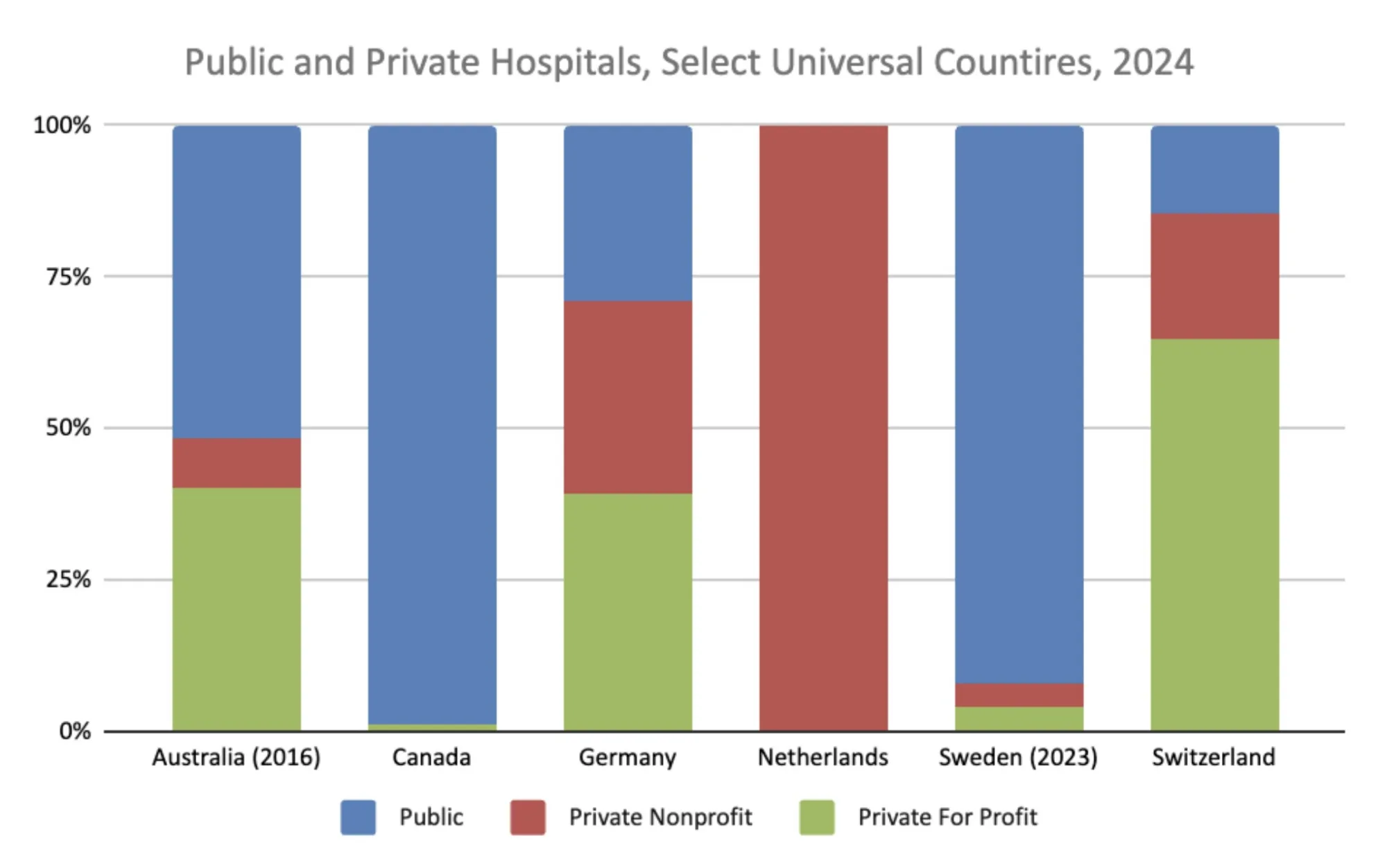
Source: OECD, 2026; FOPH, 2026; Glenngård and Ellegård, 2024.
None of these countries has suffered the increased costs, poorer service and erosion of universality that many Canadian opponents of reform claim would inevitably accompany the presence of for-profit providers. To the contrary, the experience abroad aligns with the empirical evidence, which finds for-profit hospitals are more efficient than nonprofit and government hospitals, and that a government monopoly in hospital care is less efficient, innovative and patient-focused than a competitive sector that includes private providers.
And all of these universal health-care countries do a better job delivering care to their populations for a similar or lower cost to our own.
Consider Sweden, which spends a similar amount of money on health care as Canada but has more doctors and medical technologies (e.g. MRI machines) and shorter wait times. In the 1990s, amid concerns about rising health-care spending and access to health care, the Stockholm County Council struck a deal with Capio, a private for-profit company, to take over the operation of St. Göran, a public hospital previously slated for closure.
In the early 2000s, shortly after Capio took over, St. Göran’s operation costs were between 10 and 15 per cent lower than other hospitals in Stockholm County. More recently in 2024, the hospital had the lowest average cost of treating patients among all hospitals in Sweden, running roughly 28 per cent below the national average. St. Göran has also historically had shorter lengths of stay in the ER (i.e. time from registration to discharge), fewer patients leaving before treatment is complete, lower rates of unscheduled return visits and lower mortality within a week of the visit to its emergency department. Patients at St. Göran also wait less time to be seen in emergency, with an average wait 30 to 50 minutes lower than at hospitals with similar patient characteristics (between 2016 and 2024).
These savings have clearly not come at the expense of quality care. In 2025, St. Göran topped the Swedish PeriOperative Registry’s national ranking of total hospital quality, which measures performance across a broad range of clinical and process indicators. And it had lower levels of bed overcrowding (when patients exceed available care spaces), managing 1.7 overcrowding events per 100 available beds compared to 5.1 nationally.
Or consider Australia, where again spending is similar to Canada but where patients have access to many more doctors and medical technologies (e.g. MRI machines) and endure shorter wait times.
The partnership between the public and private sectors in Australia is also vastly different from Canada’s monopolistic government-centred approach. Australia has a vibrant private hospital sector, providing services to both publicly insured patients and patients purchasing services privately. In total, Australia’s private hospitals deliver 70 per cent of non-emergency surgeries and 41 per cent of all hospital care.
Then there’s Switzerland, with again similar spending to Canada and many more physicians and medical technologies, where patients enjoy some of the most timely universal access to care in the developed world. Nearly two-thirds of Swiss hospitals are for-profit institutions providing roughly half of all hospitalizations and beds across the country, for similarly complex patients but with much lower hospital-acquired infection rates.
The same can be said for Germany and the Netherlands—similar spending, some of the most timely universal access to care, and a large role for private providers.
If Canada’s provinces want to actually solve the hospital care crisis, they should follow the lead of other higher-performing universal health-care countries and allow private for-profit providers a larger role in the hospital system.
Nadeem Esmail and Mackenzie Moir are analysts at the Fraser Institute.
The views expressed are those of the author(s). Canada Healthwatch publishes a range of perspectives and does not necessarily endorse the opinions presented.